
What Church Operational Protection Means
Church operational protection is the set of routine practices that keep your church's normal life running safely, week after week. It covers who stands where during a service, how the building is used between services, how the team talks, how incidents get written up, and how the work carries on when a leader moves away.
People also call it church safety operations or church security routines. The words differ. The idea is the same: small habits, done on a schedule, by named people.
Why Routines Matter More Than a Binder
I served on church security teams, and the plan was never the weak spot. The weak spot was the second month, when the first enthusiasm faded and nobody remembered who was posted at the side door.
A plan tells people what to do. A routine makes sure someone is there to do it. A binder on a shelf does neither by itself.
Your written plan still matters, and our church security planning guide shows where operations fit inside it. This page is about the habits that keep that plan alive.
Service-Time Coverage
Decide which posts you want covered at every service. Typical ones are the main entrance, the children's area, the parking lot and the sanctuary. Your church may choose differently.
Then schedule people to those posts ahead of time, instead of asking for volunteers on Sunday morning. A short briefing before the doors open tells everyone who is where and what has changed since last week.
Rotate people so no one serves every week for a year. Tired volunteers drift, and a rotation also gives each person a sense of the whole team.
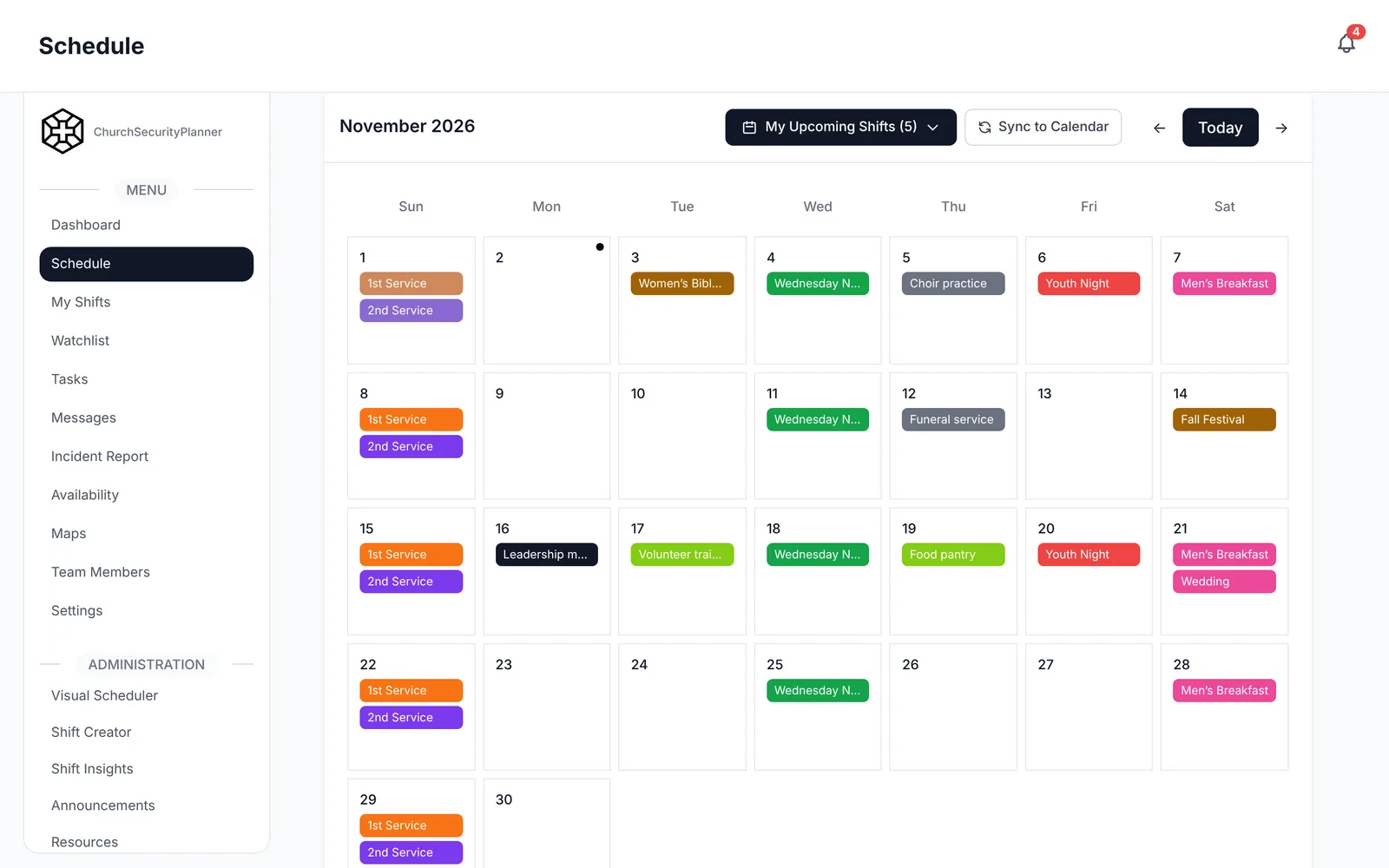
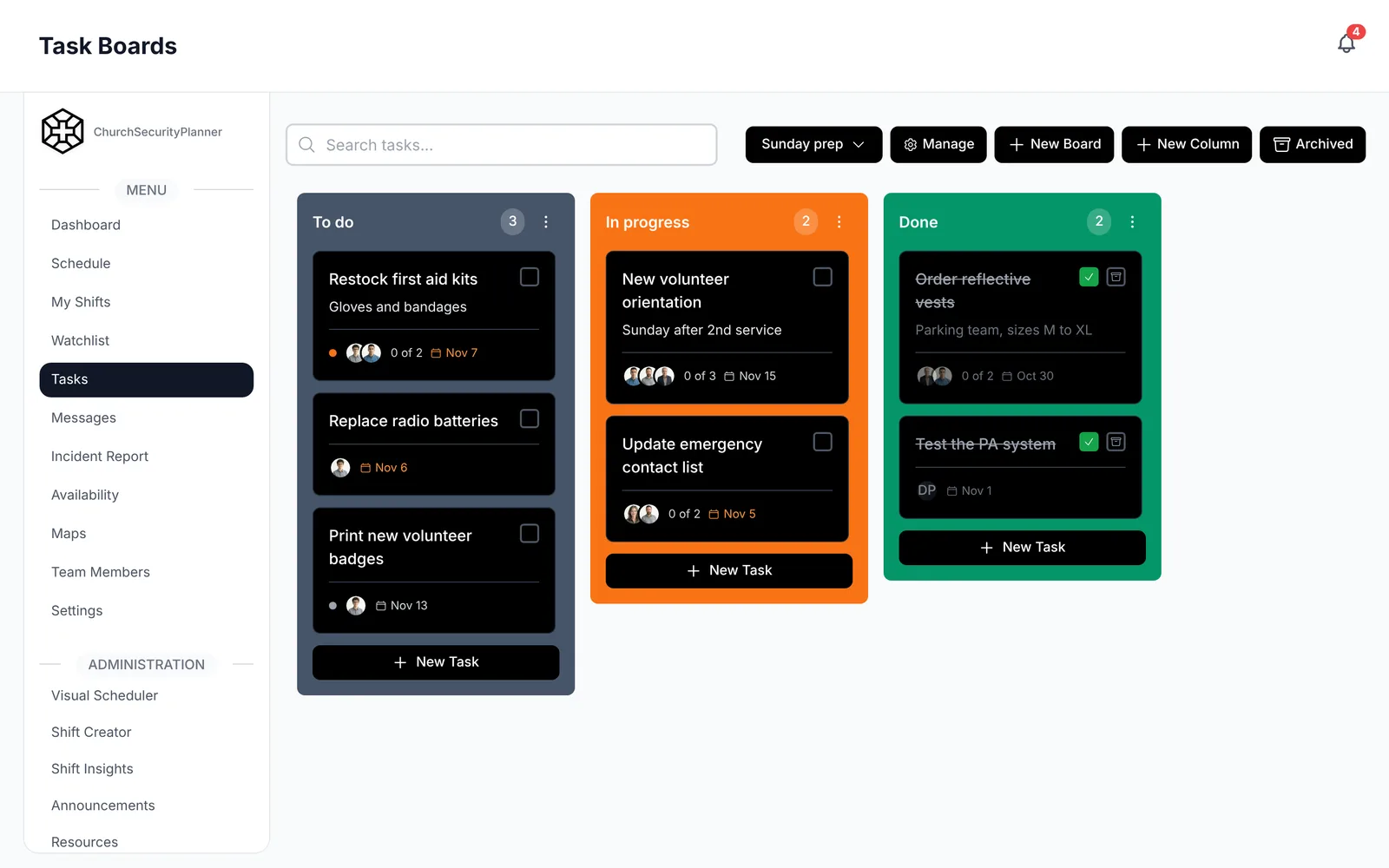
In ChurchSecurityPlanner the routines can sit on the schedule and as tasks assigned to volunteers.
Access During the Week
Sunday gets the attention. The other six days are when doors are propped open, keys go missing and a stranger walks into an empty hallway.
Decide who has keys and codes, and write the list down. Decide who is in the building on weekdays, and how a visitor is greeted and signed in. Review the list on a schedule, because people leave and rooms change use.
A short walk through the building before doors open is a simple habit. Check the entrances, the restrooms, the children's rooms and the exits. Note what you find and tell the person responsible.
Communication
Pick one way the team talks to each other, and use it every week. Volunteers should know where to look for the schedule, where to post a concern and who to call first.
Keep messages short and specific: who, where, what you saw. The same channel should carry the weekly reminder and the thank-you.
Incident Reporting
Write up every incident the same day, while the details are fresh. That includes the small ones, such as a medical moment, a missing child who was found, or a door found unlocked. Our incident report template shows what to capture.
Once a month, read the reports together. Patterns show up that no single report reveals, such as the same door or the same hour.
Continuity
Continuity means the routines survive changes. If your team lead moves away, can someone else pick up the sheet and carry on?
Keep the schedule, the roster, the written plan and the routine sheet where more than one person can open them. Name a backup for each role, and train that person.
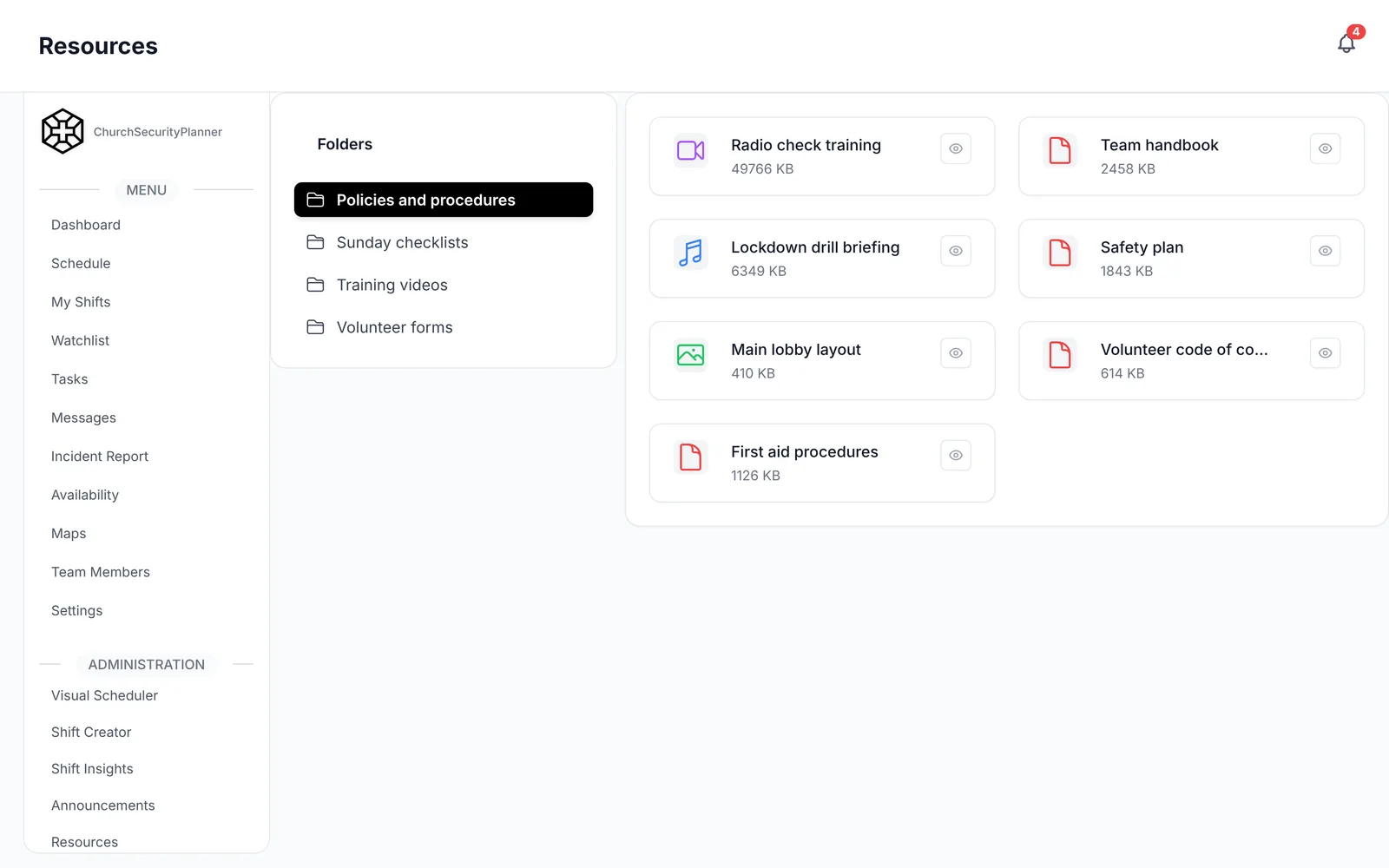
A resource library with folders such as Policies and procedures and Sunday checklists is one way to keep those documents together where the team can find them.
A Routine Sheet for Your Church Safety Team
Copy the three lists below into a document you can edit and print. Add the name of the person responsible beside each line.
This is an example to adapt to your church.
Weekly
- Posts scheduled for every service: [post], [name], backup [name].
- Short team briefing before doors open, led by [name].
- Building walk before doors open, done by [name].
- Incidents written up the same day by [name].
- Next week's schedule sent to the team by [day].
Monthly
- First-aid kit and AED check by [name]; supplies replaced as needed.
- Review the month's incident reports with [team lead].
- One short training session on [topic], led by [name].
- Door and key review: who holds keys and codes, and who no longer needs them.
Yearly
- Review the written plan with church leadership, [month].
- Run drills for [medical, fire, weather], [months].
- Review roles and the team roster; confirm a backup for each role.
- Renew trainings through recognized courses in first aid, CPR and AED, as your church decides.
Start with the weekly list alone for a month. Add the monthly and yearly lists once the weekly habits hold.
Making the Routines Stick
Give each routine one owner. A task owned by the whole team is owned by no one.
Keep the sheet short enough to read in two minutes, and change it when something does not fit your church. Ask the team at your yearly review which routines they skip, and why.
If you are building your team schedule, our schedule template is a good next step, and the church security checklist covers the walk-through items in more detail.
Trenton J. Reagan is the founder of ChurchSecurityPlanner, a former youth pastor and church security team member. He was trained in church protection protocols by law enforcement and military professionals and has a lifelong background in firearms training and tactical preparedness. ChurchSecurityPlanner was built in response to a direct request from his father, Pastor Clint Reagan of Calvary Chapel Knoxville — a congregation of 5,000 — who needed a comprehensive tool to manage his security teams.